Showing posts with label quark. Show all posts

29 Oct 2012

Where do heavy elements come from?

Where do heavy elements come from?


Remnants of Supernova Tycho courtesy of mpia.de


Stars are powered by nuclear fusion – any atom heavier than this is formed by this process. When a star starts running low on Hydrogen, it will begin 'burning' the Helium too, forming even heavier elements. Unlike Hydrogen being fused to Helium, this is a process of diminishing returns. Each new elemental fusion yields less energy than the previous. At a certain point, depending on the stars mass, this process grinds to a halt, and the star can go no further. If this star is small, like our sun, it will eventually burn out, as a red giant and eventually a white dwarf. When this occurs the star will retain the heavier elements it formed during its lifetime. However, if it is a bit bigger, though, its undergo core collapse when nuclear fusion suddenly becomes unable to sustain the core against its own gravity. The collapse may cause violent expulsion of the outer layers of the star resulting in a supernova - tremendous energy is suddenly released in the form of neutrinos and electromagnetic radiation. Such is the explosive energy unleashed during a Supernova event that even the poorest grade of fuel, the middle-weight elements like Iron, aren't safe from atomic infusion. Brief though the blast is, compared with the life of the star, a Supernova packs enough energy to force the creation of Uranium, and even more dense, and more unstable elements. The blast is also powerful enough to eject these ultra-dense atoms out into the surrounding cosmos.
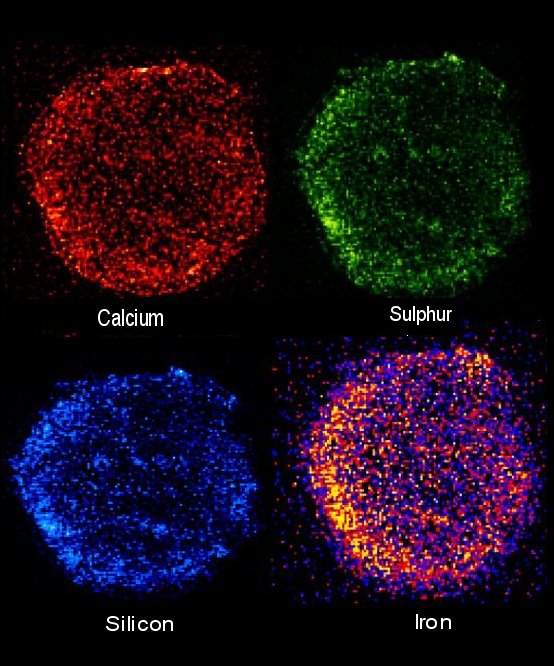


Constituent elements of Supernova Tycho courtesy of sci.esa.int


Stars & Nuclear Fusion


Supernovae are a key source of elements heavier than oxygen. These elements are produced by nuclear fusion (for iron-56 and lighter elements), and by nucleosynthesis during the supernova explosion for elements heavier than iron. 

Nuclear fusion is the process by which two or more atomic nuclei join together, or "fuse", to form a single heavier nucleus. During this process, matter is not conserved because some of the mass of the fusing nuclei is converted to energy which is released. Fusion is the process that powers active stars. The fusion of two nuclei with lower masses than iron (which, along with nickel, has the largest binding energy per nucleon) generally releases energy, while the fusion of nuclei heavier than iron absorbs energy.

A substantial energy barrier of electrostatic forces must be overcome before fusion can occur. At large distances two naked nuclei repel one another because of the repulsive electrostatic force between their positively charged protons. If two nuclei can be brought close enough together, however, the electrostatic repulsion can be overcome by the strong nuclear force, which is stronger at close distances. This is one of the most important fusion process in nature. The net result is the fusion of four protons into one alpha particle, with the release of two positrons, two neutrinos (which changes two of the protons into neutrons), and energy, but several individual reactions are involved, depending on the mass of the star. For stars the size of the sun or smaller, the proton-proton chain dominates.

Unlike the proton–proton chain reaction, the CNO cycle is a catalytic cycle. Theoretical models show that the CNO cycle is the dominant source of energy in stars more massive than about 1.3 times the mass of the Sun. In the CNO cycle, four protons fuse, using carbon, nitrogen and o

8 Oct 2011

Image of the Day - CERN Still Looking


Today's Image of the Day for 8/10/11 - CERN Still Looking

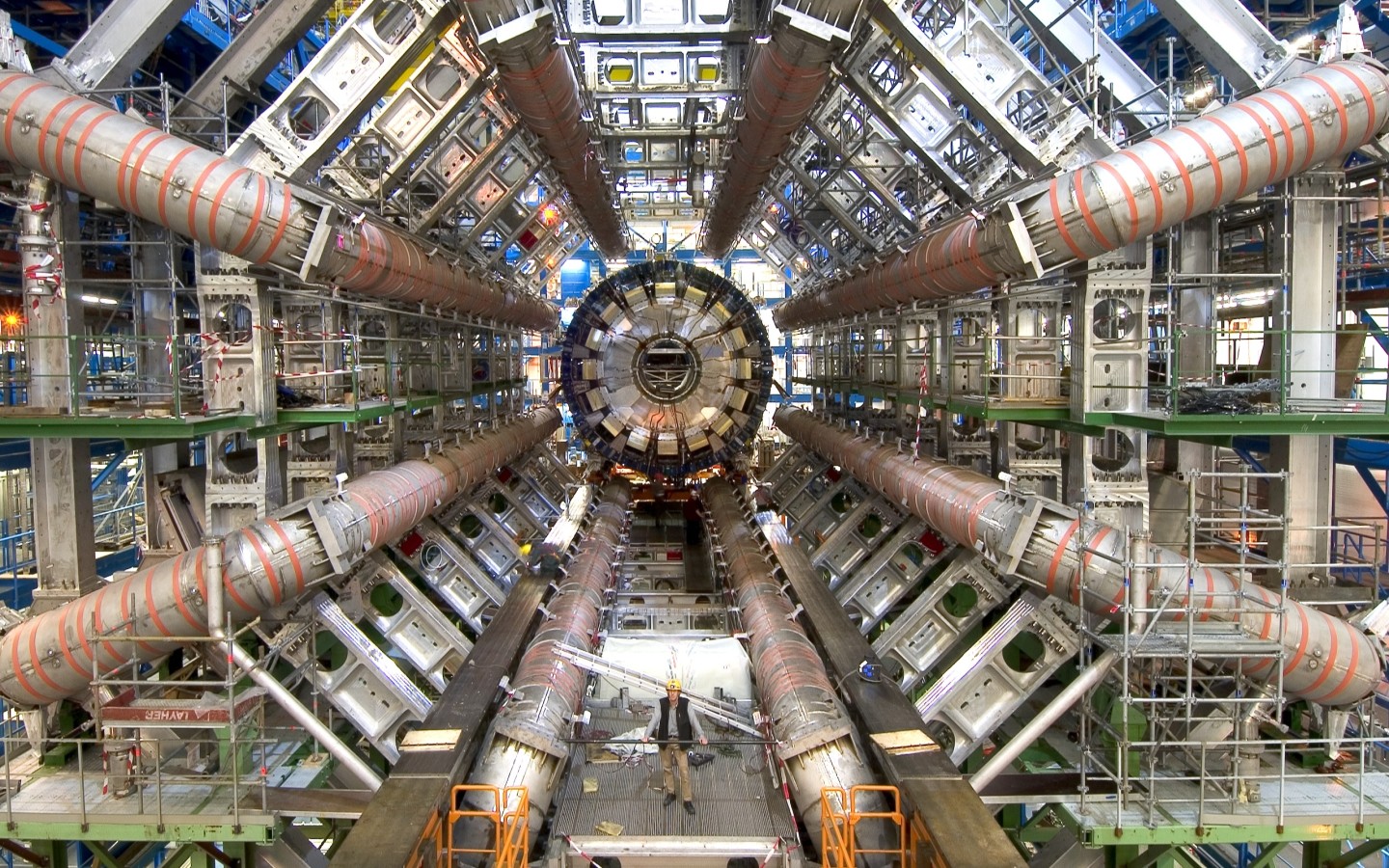
CERN detector courtesy of zastavki

The long-sought after Higgs boson particle will be found in the next 12 months if it exists, said the leader of the CERN facility in Geneva. The three scientists, one from each of CERN, the U.S. Fermilab and Japan's KEK - also stated their scepticism of recent claims that particles had recently broken the speed of light in the Large Hadron Collider (LHC). 'I think by this time next year I will be able to bring you either the Higgs boson or the message that it doesn't exist,' said Rolf Heuer, director general of CERN, whose LHC is at the focus of the search. He was echoed by KEK's Atsuto Suzuki and Pier Oddone of Fermilab, which last weekend shut off - after 26 years - its Tevatron accelerator, which has also been seeking the Higgs in the debris of billions of particle collisions. Oddone said analysis of the data gathered in the Tevatron, which for nearly a decade led the search, would be under analysis for several more months but at best could only now reveal where the Higgs was not hiding. Existence of the particle - believed to have given shape to the universe after the Big Bang 13.7 billion years ago - was proposed some four decades ago. 'Last month Guido Tonelli, a spokesman for the Compact Muon Solenoid Detector, a huge particle detector at CERN, said that even if the LHC was able to rule out the existence of the Higgs boson, that would be a major achievement in itself. Another CERN spokesman said that the Higgs boson was not the only solution to the mystery of the universe.But even if the elusive particle is not found, the experiments, which use the 'ring' to smash streams of protons together at nearly the speed of light, creating billions of 'miniature Big Bangs', will still expand human knowledge - even if it is simply by exposing flaws in the Standard Model of physics, accepted since the Seventies as a system to 'explain' matter. Speaking earlier this year, Tonelli said, 'We've reached the edge of the unknown. It's all new physics from now.'

Image of the Day - Draconid Meteor Shower


Today's Image of the Day for 7/10/11 - Draconid meteor shower

Draconid meteor shower courtesy of dailymirror

The meteors become visible as the earth crosses the orbit of the 21P/Giacobini-Zinner comet. The comet's orbit path is filled with tiny particles - the size of a grain of sand. When our planet zips through this cosmic dust storm the particles disintegrate in our atmosphere and create streaks of light across the sky. However, because this year's schedule of meteor showers happens to coincide with the full moon cycle, they may be difficult to spot with the sky so brightly lit. Because the Draconids move relatively slowly in stellar terms - 12 miles per second - they're faint and the moonlight tends to wash them out. The meteor shower is named after the constellation from which they appear to emerge, which in this case is Draco, the dragon. The Draconids have previously put on some spectacular shows. In 1933 and 1946 observers reported an astounding rate of 20,000 shooting stars an hour, leading one Irish astronomer to describe the 1933 episode as being like a flurry of snowflakes. If this Draconid shower isn't visible, there won't be another chance to catch it until 2018. Instead you will have to satisfy yourself with the arrival of the Orionids on October 22 - remnants from Halley's Comet - which are expected to number a rather more sedate 20 meteors an hour. Then there are the Leonids in mid-November - with as many as 100 meteors an hour - but it may not be any easier to glimpse those to showers either.


'Next year will be better.'


3 Oct 2011

Image of the Day - Tevatron


Today's Image of the Day for 3/10/11 - Tevatron

Tevatron courtesy of visualmedia.fnal

One of the world's most powerful "atom smashers", at the leading edge of scientific discovery for a quarter of a century, has been shut down. The Tevatron facility near Chicago fired its last particle beams on Friday after federal funding ran out. Housed in a 6km-long circular tunnel under the Illinois prairie, the Tevatron leaves behind a rich scientific legacy. Since 1985, engineers have been accelerating bunches of proton and antiproton particles around the Tevatron's main ring at close to the speed of light, then smashing them together in a bid to unlock the secrets of the Universe. This includes finding nature's heaviest elementary particle: the top quark. But the Tevatron has been superseded by the Large Hadron Collider (LHC) - located on the French-Swiss border - which is capable of getting to much higher energies than the US machine. The Tevatron's main ring is likely to be used in other experiments, and components may be transferred to other accelerators, with Fermilab concentrating on smaller-scale experiments such as Project X - an effort to develop ever more intense particle beams.